

TREND FOR

MINIATURIZATION

What Is a Water Chiller Evaporator and How Does It Work?

A Water Chiller Evaporator is the quiet working chamber where heat leaves process water. It does not create cold directly. Instead, it transfers heat into a flowing refrigerant. That change sounds simple. The details are not.

Willis H. Carrier, a pioneer of modern air conditioning, wrote, “Air conditioning means the control of the humidity of the air, the control of its cleanliness, the control of its motion, and the control of its temperature.” His statement helps explain the wider purpose behind chiller design. A Water Chiller Evaporator supports that purpose by controlling temperature through a carefully managed refrigeration cycle. Warm water enters the evaporator shell or plate channels. Refrigerant absorbs its heat and boils at low pressure. Cooler water then returns to the building or production line.

The process depends on more than temperature difference. Flow rate, refrigerant pressure, tube cleanliness, and approach temperature all matter. A thin scale layer can act like an unwanted blanket. Poor flow can create uneven cooling. That is where field experience becomes important. Engineers inspect leaving-water temperature, suction pressure, vibration, and frost patterns. They also compare readings over time.

A perfect explanation would be misleading. Real systems behave differently. Manufacturer data gives direction, not certainty. This guide explores the evaporator’s construction, heat-transfer path, controls, common failures, and maintenance practices. It also asks a practical question: what happens when a small performance change signals a larger system problem?
What Is a Water Chiller Evaporator and How Does It Work?

Water Chiller Evaporator: Definition and Core Purpose

A water chiller evaporator is the heat exchanger where refrigerant absorbs heat from circulating water. Its core purpose is simple: remove unwanted heat from the water loop. The cooled water then travels to air-handling units, process equipment, or other cooling loads. In many systems, water enters near 12°C and leaves near 7°C. The exact temperatures depend on design and operating conditions.

Inside the evaporator, low-pressure refrigerant changes from liquid into vapor. This phase change requires heat, which comes from the passing water. A shell-and-tube evaporator uses separate passages for water and refrigerant. A plate design uses thin, corrugated plates instead. Neither fluid should mix. It is not a storage tank.

Reliable operation depends on steady water flow, clean heat-transfer surfaces, and accurate temperature sensors. Fouling can create an invisible insulating layer, reducing cooling capacity while increasing energy use. Low flow may cause freezing risks, especially when leaving-water temperature is set too low. Small errors matter. During commissioning, technicians often compare entering and leaving temperatures, pressure readings, and actual flow. This practical check can reveal problems that a control screen misses.

The evaporator also connects the cooling load to the refrigeration cycle. After absorbing heat, the refrigerant vapor moves toward the compressor. If the evaporator is oversized, undersized, dirty, or poorly controlled, the entire chiller may perform inefficiently. A careful design review should consider fluid quality, pressure drop, maintenance access, and seasonal load changes. Some assumptions still fail in real buildings. Door openings, unstable flow, and neglected strainers can change performance quickly.

How the Evaporator Transfers Heat from Chilled Water

What Is a Water Chiller Evaporator and How Does It Work?

How the Evaporator Transfers Heat from Chilled Water

A water chiller evaporator is the heat-transfer section where chilled water loses unwanted heat. Warm return water enters the evaporator from the building loop. Refrigerant flows on the opposite side of a metal surface, usually through tubes or around them. The refrigerant absorbs heat and changes from a low-pressure liquid into vapor. The water leaves several degrees cooler, then returns to air-handling units or process equipment.

The process depends on a controlled temperature difference. A pump moves water through the evaporator, while sensors monitor entering temperature, leaving temperature, pressure, and flow. If water enters at 12°C and leaves at 7°C, the evaporator has removed sensible heat from the loop. In field service, technicians often check the approach temperature and inspect for fouled surfaces. Even a thin layer of scale can reduce heat transfer. A simple explanation can miss an important detail: refrigerant charge, water flow, and load must remain balanced. Real systems are less predictable than diagrams suggest.

Tips: Keep the water circuit clean and maintain reliable flow. Check strainers regularly. Never ignore unusual pressure changes or a rising leaving-water temperature. Insulation also matters, because condensation around cold piping can signal a hidden problem. Temperature readings should be compared over time, not judged from one measurement.

Key Components Inside a Water Chiller Evaporator

What Is a Water Chiller Evaporator and How Does It Work?

Key Components Inside a Water Chiller Evaporator

A water chiller evaporator transfers heat from chilled water to a refrigerant. Its main job is simple, but its internal flow deserves careful attention. Water passes through tubes or narrow plates, while low-pressure refrigerant surrounds them. The refrigerant absorbs heat and changes from liquid into vapor. The compressor then draws this vapor away. This cycle cools the water for air-conditioning or industrial processes.

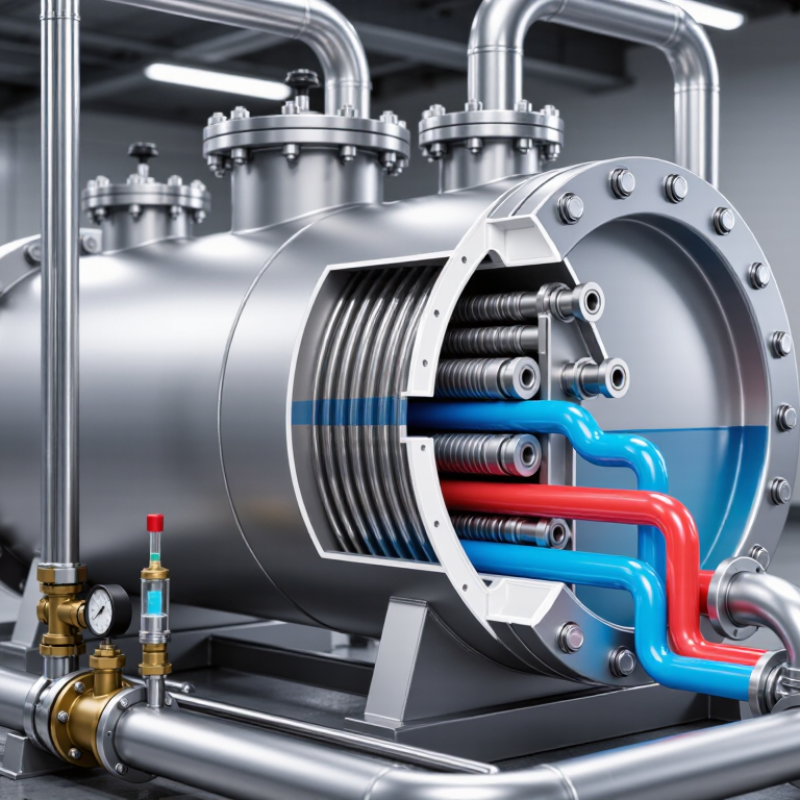
A shell-and-tube evaporator commonly includes a steel shell, heat-transfer tubes, water boxes, and internal baffles. The tubes separate the water from the refrigerant. Baffles guide refrigerant movement and reduce uneven flow. In a plate design, stacked metal plates create alternating water and refrigerant channels. Gaskets or brazed joints keep these paths separated. The expansion valve sits upstream and controls refrigerant entering the evaporator. Sensors monitor temperature, pressure, and sometimes water flow.

During field inspections, technicians check for fouled tubes, weak insulation, unusual pressure readings, and restricted water flow. A thin mineral layer can reduce heat transfer noticeably. Poor flow may also cause freezing near the evaporator outlet. That assumption can fail. Sensor placement, refrigerant charge, and water quality all influence performance. I have found that clean components do not always mean efficient operation. Flow balance and accurate measurements matter just as much.

Step-by-Step Refrigeration Cycle in the Evaporator

A water chiller evaporator is the point where heat leaves chilled water. The process begins when low-pressure refrigerant enters the evaporator shell. Its pressure keeps the refrigerant’s boiling temperature below the entering water temperature. Heat then moves through the tube walls into the refrigerant.

Step by step, warm return water enters near 12°C and flows across the tubes. Refrigerant absorbs this heat and changes from liquid to vapor. The water may leave near 7°C, depending on the design and load. A compressor then receives the vapor, but the evaporator must prevent liquid carryover. That detail is easy to underestimate. Even a small amount of liquid can damage compressor components.

Sensors monitor entering and leaving water temperatures, refrigerant pressure, and superheat. If water flow falls, heat transfer weakens and freezing risk increases. Fouled tubes create the same problem, although operators sometimes blame the refrigerant first. ASHRAE guidance emphasizes stable flow, correct approach temperature, and clean heat-transfer surfaces. AHRI Standard 550/590 provides rating methods for water-chilling packages, supporting comparable capacity and efficiency tests. The International Energy Agency reported that space cooling represented about 10% of global electricity use in its Future of Cooling analysis. Therefore, evaporator performance has practical energy consequences. Real systems are less perfect than diagrams suggest. Load changes, air pockets, and sensor drift can disturb the cycle within minutes.

What Is a Water Chiller Evaporator?

The evaporator is the heat exchanger where low-pressure refrigerant absorbs heat from the chilled water. In a typical water chiller, water enters at about 12°C and leaves at about 7°C, while the refrigerant evaporates at a lower temperature to drive heat transfer.

Typical Evaporator Operating Temperatures

As the refrigeration cycle progresses, the refrigerant boils inside the evaporator, removes heat from the water circuit, and leaves the evaporator as a slightly superheated vapor before returning to the compressor.

Common Evaporator Types and Their Operating Differences

A water chiller evaporator transfers heat from chilled water to refrigerant. Inside the exchanger, refrigerant boils at low pressure and absorbs heat. The cooled water then returns to air-handling coils or process equipment. A typical outlet temperature may be 6°C, but the exact setting depends on the load.

Shell-and-tube evaporators are common in medium and large chillers. Water flows through copper tubes, while refrigerant surrounds them inside a steel shell. They tolerate pressure changes and can often be mechanically cleaned. Flooded designs place the tubes in a refrigerant bath. Heat transfer is effective, but oil return and refrigerant-level control require careful engineering. Direct-expansion designs move refrigerant inside the tubes. They are compact and respond quickly, yet poor water flow can create freezing risks.

Brazed-plate evaporators use many thin metal plates with alternating water and refrigerant channels. Their small footprint suits compact systems. However, narrow passages react badly to dirt, scale, and sudden flow loss. A practical inspection checks the water temperature difference, pressure drop, strainers, and insulation around the evaporator. Small details matter. A clean plate exchanger can outperform a larger dirty one. Still, the most efficient design on paper may fail in a plant with unstable water quality. Engineers sometimes focus too heavily on rated capacity and overlook maintenance access. That mistake deserves a second look.

What Is a Water Chiller Evaporator and How Does It Work? - Common Evaporator Types and Their Operating Differences

Evaporator Type Basic Operating Principle Refrigerant-Side Flow Water-Side Arrangement Typical Heat-Transfer Characteristics Main Advantages Common Limitations Typical Applications
Flooded Shell-and-Tube The refrigerant boils around tubes carrying chilled water. The shell is maintained with a liquid refrigerant level so the tube bundle remains wetted during operation. Liquid refrigerant enters the shell, absorbs heat, and vaporizes. A vapor outlet and mist-eliminating arrangement help prevent liquid carryover to the compressor. Water normally flows inside the tubes, often in multiple passes to achieve the required temperature difference and velocity. High and relatively uniform refrigerant-side wetting can provide strong heat transfer and a small approach temperature when properly controlled. Good efficiency at larger capacities; stable heat transfer; well suited to central chilled-water systems. Larger refrigerant charge; requires careful oil return, level control, and protection against liquid entering the compressor. Large commercial buildings, industrial process cooling, district cooling, and high-capacity water chillers.
Dry-Expansion Shell-and-Tube An expansion valve meters refrigerant into the tube circuit. The refrigerant evaporates while flowing through the tubes, and the chilled water circulates around them inside the shell. A liquid-vapor mixture enters the tubes and leaves as a slightly superheated vapor. Superheat control helps ensure that liquid does not reach the compressor. Water flows through the shell side around the refrigerant tubes; baffles guide the water and improve mixing and heat transfer. Heat transfer is generally lower than in a well-designed flooded arrangement, but performance is predictable and easy to regulate with an expansion valve. Lower refrigerant charge than many flooded designs; good liquid protection; comparatively straightforward control and service. May require a larger heat-transfer surface for the same capacity; performance can decline if superheat or refrigerant distribution is poorly controlled. Packaged air-cooled or water-cooled chillers, comfort cooling, and medium-capacity industrial systems.
Brazed Plate Evaporator Thin corrugated plates are brazed together to form alternating refrigerant and water channels. Heat passes through the plates while the two fluids remain separated. Refrigerant expands and evaporates in dedicated plate channels, commonly in a counterflow arrangement relative to the water. Chilled water flows through adjacent channels, usually in counterflow to improve the temperature approach. High surface-area-to-volume ratio and strong turbulence provide efficient heat transfer in a compact package. Compact size; low internal volume and refrigerant charge; relatively light weight; efficient at small and medium capacities. Narrow water passages are sensitive to dirt, scale, and freezing; cleaning is more difficult than with a removable tube bundle. Small packaged chillers, heat pumps, process cooling, and space-limited installations with well-filtered water.
Falling-Film Evaporator Liquid refrigerant is distributed over the outside of a tube bundle and forms a thin film as it flows downward and evaporates on the tube surfaces. Refrigerant is supplied to a distribution system above the tubes; vapor exits while unevaporated liquid is collected and recirculated or managed by the circuit design. Water usually flows inside the tubes, while refrigerant boils on the external tube surfaces. A thin liquid film reduces refrigerant-side thermal resistance and can support efficient operation with a relatively low refrigerant inventory. Reduced refrigerant charge compared with many flooded designs; efficient part-load potential; suitable for larger modern chiller systems. Requires accurate liquid distribution; low-load operation and oil return must be carefully managed; design is more complex than a basic DX arrangement. Large commercial chillers, energy-conscious HVAC plants, and applications where refrigerant charge reduction is important.
Shell-and-Coil Evaporator A coiled tube carries either the refrigerant or the water inside a shell containing the other fluid. Heat is transferred through the coil wall. Depending on the design, refrigerant may evaporate inside the coil as a DX circuit or boil around the coil in a flooded configuration. The secondary fluid occupies the shell side and flows around the coil; internal baffles or flow guides may improve circulation. The coil geometry provides a simple heat-transfer surface, although distribution and cleanability depend strongly on the specific design. Simple construction; useful for compact or specialized systems; can tolerate certain flow arrangements that are difficult for plate exchangers. Generally less compact than brazed plates and may have lower heat-transfer effectiveness than optimized shell-and-tube or plate designs. Small chillers, packaged equipment, storage tanks, and specialized process-cooling systems.
How a water chiller evaporator works: Low-pressure refrigerant absorbs heat from the returning chilled water and changes from a liquid or liquid-vapor mixture into vapor. The cooled water is then circulated to air-handling units, fan-coil units, or industrial process equipment. The refrigerant vapor flows to the compressor, completing the vapor-compression refrigeration cycle.