What Are the Top Types of Crystal Singing Bowls?
Interest in sound-based wellness has grown alongside the wider wellness economy. The Global Wellness Institute valued that economy at $5.6 trillion in 2022 and projected $8.5 trillion by 2027. Those figures describe a broad market, not crystal singing bowl sales. Still, they help explain why more buyers are comparing bowl materials, shapes, and tones.
A Crystal Singing Bowl is commonly made from fused silica, and its sound can vary with its size, thickness, and playing technique. Shoppers may encounter clear bowls, frosted bowls, and models marketed with added minerals or colored finishes. These labels are not always standardized. The distinction matters. A bright, sustained note may appeal in a meditation room, while a lower tone may feel more grounding to some listeners. Personal preference is real, but it is not a clinical measure.
Research offers useful context, with an important limitation. Goldsby and colleagues’ 2017 observational study in the Journal of Evidence-Based Complementary & Alternative Medicine followed 62 adults during singing-bowl meditation and reported improvements in several self-reported mood measures. The study did not establish that crystal bowls produce the same effects, or that one bowl type works best. That gap deserves attention. This guide compares common types by construction, sound, and practical use, while separating maker claims from published evidence. Small details count: how a bowl feels in the hand, how clearly it rings, and whether its tone remains comfortable in your space.
Crystal Bowl Basics: Quartz Composition and Its Mohs Hardness of 7
Crystal singing bowls are commonly made from high-purity silica, often derived from quartz. The silica is heated until it fuses into a hard, glass-like material. This process changes its structure: fused silica does not have the same orderly crystal pattern as natural quartz.
Quartz has a Mohs hardness of 7. That number describes its resistance to scratching compared with other minerals; it does not mean a bowl is unbreakable. Mohs hardness is a useful reference, but it is not a direct durability rating for every finished bowl. A bowl can still chip or crack if its rim strikes a countertop or another bowl. Handle it gently.
Frosted and clear bowls are common styles, often distinguished by their surface finish and appearance rather than a different basic ingredient. Their tone also depends on factors such as shape, wall thickness, and how they are played. A soft mallet around the rim may produce a sustained note, while a light strike can sound sharper. Small differences matter. It is easy to assume that hardness tells the whole story, but it does not; careful handling and the bowl’s construction matter too.
Frosted Quartz Bowls: Opaque Finish and Common Construction
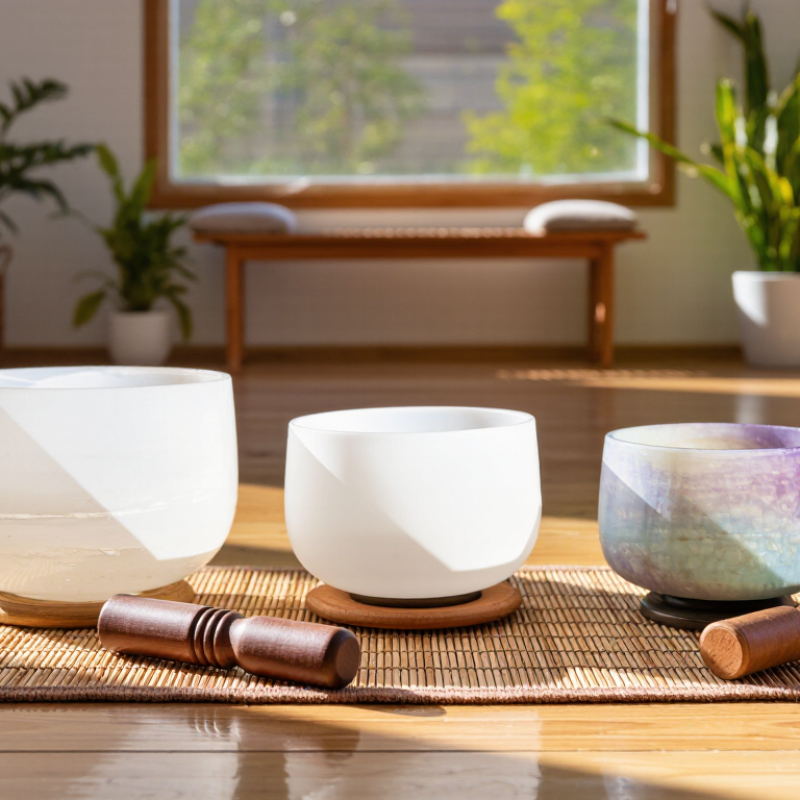
Frosted quartz bowls have a matte, opaque surface that scatters light instead of reflecting it like a polished bowl. Many are formed by heating high-purity silica powder and shaping the material into a resonant vessel. The cloudy finish can make the bowl look softly white, with tiny variations across the surface. It is a visual feature, not proof of better tone. Sound also depends on the bowl’s diameter, wall thickness, rim, and how it is played.
The U.S. Geological Survey’s Mineral Commodity Summaries 2024 estimated U.S. industrial sand and gravel production at about 120 million metric tons in 2023. That broad category serves many industries; it is not a measure of bowl-grade quartz. One limitation: public production reports rarely separate material used for singing bowls. So, claims about exact purity or sound quality deserve careful checking. A frosted surface can also hide small marks, making close inspection worthwhile.
Tips: Check the rim for chips and look for even wall thickness. Tap gently with a padded mallet and listen for a clear, sustained tone. Compare bowls in the same room; acoustics can shift what you hear. Frosted bowls may show wear unevenly. That’s worth considering.
Clear Quartz Bowls: Transparent Design and Note-Based Tuning
Clear quartz singing bowls are known for their transparent, glasslike appearance and bright, sustained tones. Their walls catch window light, revealing subtle variations in thickness and shape. When gently struck, a bowl may produce a clear fundamental note with softer overtones above it. The exact sound depends on more than its appearance. A small detail matters.
Many bowls are described by musical note, such as C or F, and some sellers provide a measured frequency. These labels help when choosing bowls for a set, but pitch can shift slightly with playing pressure, temperature, and the room’s acoustics. Check how the bowl sounds at a comfortable volume, and compare it with a reliable tuner if precise matching matters. A note label is a reference, not a guarantee of identical sound across every instrument. Still, the labels can feel more certain than the sound. That is worth remembering. A bowl may ring beautifully yet feel too sharp or too persistent in a small room. Listening in person, when possible, gives a more useful impression than a specification alone.
Clear Quartz Singing Bowls: Note Frequencies
Transparent clear quartz bowls can be tuned to musical notes. This chart shows the standard equal-temperament frequencies for notes in octave 4, using A4 = 440 Hz as the reference.
Actual bowl pitches may differ from these reference frequencies depending on the instrument and tuning.
Gemstone-Infused and Alchemy Bowls: Added Materials and Variations
What Are the Top Types of Crystal Singing Bowls?
Gemstone-Infused and Alchemy Bowls: Added Materials and Variations
Gemstone-infused bowls combine quartz with small amounts of minerals or other materials. Makers may describe them as rose quartz, amethyst, or tourmaline bowls, based on the added material. The color can be striking: a violet rim, cloudy pink swirls, or tiny flecks caught in clear glass. Still, appearance and sound vary between pieces. Added minerals do not guarantee a particular tone or wellness effect.
Alchemy bowls take this variation further. They may blend quartz with metals, gemstones, or other materials, creating distinct colors and timbres. A bowl might sound bright and lingering, while another feels softer and more muted. Listen in person when possible; room acoustics and playing technique also shape what you hear. Small differences matter.
Interest in these instruments sits within a much larger wellness market. The Global Wellness Institute’s 2024 Global Wellness Economy Monitor reported that the wellness economy reached $6.3 trillion in 2023 and projected $9 trillion by 2028. That figure covers many sectors, not crystal bowls specifically, and it does not prove therapeutic benefits. Treat descriptions of added materials as product details, not medical claims. And check the basics: bowl size, weight, included mallet, and return terms. A beautiful bowl may still be awkward to play.
Comparing Bowl Types by Pitch: ISO 16:1975 Sets A4 at 440 Hz
When comparing crystal singing bowls by pitch, ISO 16:1975 offers a useful reference: it sets the tuning note A4 at 440 Hz. This does not mean every bowl should sound at A4. A bowl may produce a different musical note, and its pitch depends largely on its dimensions and construction. Larger bowls often produce lower tones, while smaller ones tend to sound higher. That is a tendency, not a guarantee.
Frosted, clear, and handled bowls describe different designs, not fixed pitch categories. Two bowls of similar size can still sound different. Listen for the fundamental tone, then notice the higher partials that shimmer above it. A phone tuner can help, but room echo and microphone placement may shift its reading. Check the bowl in a quiet space, using the same striker and a gentle, consistent touch. Small differences matter. ISO’s 440 Hz reference helps musicians compare pitches, but it is not a quality score for singing bowls. I would avoid assuming that a bowl marked A is exactly 440 Hz without a reliable measurement; even careful readings can vary slightly.