

TREND FOR

MINIATURIZATION

China Top 10 Lip Gloss Plumper Suppliers for Global Buyers

China’s cosmetics manufacturing sector offers global buyers a wide range of lip products, including the increasingly popular Lipgloss Plumper. Yet a polished sample is only the beginning. Buyers also need to assess formula transparency, packaging quality, production capacity, communication, and consistency between samples and bulk orders.

Cosmetic chemist Dr. Michelle Wong is known for evidence-based beauty education. A practical takeaway from her approach is: “Assess the formula and evidence, not the marketing promise alone.” This is a paraphrased principle, not a direct quotation. It matters when comparing plumping glosses, where ingredient details, wear comfort, and substantiated product claims deserve closer attention than dramatic packaging alone.

This guide introduces ten China-based suppliers for global buyers to investigate. It is a starting point, not an endorsement. Supplier capabilities and product ranges can change, so confirm current information directly. Ask for ingredient documentation, samples, quality-control details, and clear specifications for packaging and production. Check the small details. A shade can look warmer under showroom lights; a tube may feel different after repeated use. Even a careful comparison has limits: public profiles rarely reveal every production constraint. Diligent buyers should verify claims, document expectations, and allow time for sample review before making a sourcing decision.
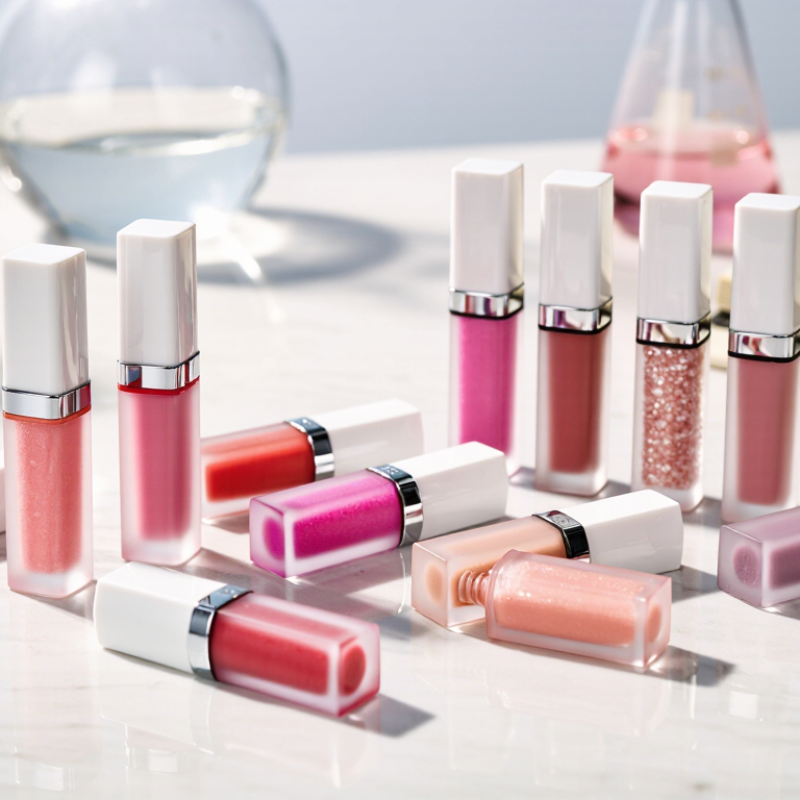
China Top 10 Lip Gloss Plumper Suppliers for Global Buyers

Lip Gloss Plumpers: Product Types, Active Ingredients, and Core Performance Metrics

Lip gloss plumpers generally fall into three groups: shine-enhancing glosses, conditioning formulas, and sensory plumpers that create a temporary fuller look. Warming agents, such as vanillyl butyl ether, and cooling agents, such as menthol, can produce a noticeable sensation. Hyaluronic acid and emollients mainly support hydration and a smoother surface; they do not permanently enlarge lips. A quick tingle is not proof of performance.

Grand View Research valued the global lip-care products market at about USD 2.03 billion in 2023 and forecast 5.3% annual growth through 2030. That broad category includes many products, not plumpers alone, but signals strong competition for reliable claims. For supplier comparisons, request controlled before-and-after images, hydration readings, and wear-time results. Corneometry can track surface hydration; standardized photography can help assess visible fullness. Record sting and irritation scores too. The uncomfortable bit matters. Results can vary with lip condition, application amount, and tolerance, so one test panel may not tell the whole story. Stability checks should also confirm that gloss texture, scent, and applicator delivery remain consistent over time.

How China’s OEM/ODM Supply Chain Supports Global Lip Plumper Buyers

For global buyers, China’s OEM/ODM supply chain can bring formulation, filling, packaging, and export coordination into one project. Buyers can define a cooling sensation, sheer tint, or thicker gloss texture and review lab samples before approving production. Small details matter. A tube’s wiper opening can affect how much product comes out, while the applicator shape changes coverage on the lips. Suppliers may offer stock packaging or develop custom components, depending on order volume, budget, and schedule.

A dependable process includes written product specifications, sample approval, batch records, and documented quality checks. Ask for relevant test reports, such as stability results for the chosen formula and packaging combination. A good-looking sample alone is not enough. It may behave differently after storage or during transport. Buyers should also confirm minimum order quantities, lead times, component sourcing, and who handles each export document. Clear communication helps prevent shade, texture, or packaging mismatches, but it cannot remove every production risk. Even experienced teams may need another sample round when a small formula change affects feel or shine. Prepare room for that.

China Lip-Plumper OEM/ODM: EU Labeling Checks for Global Buyers

A practical compliance reference for buyers sourcing lip plumpers. The chart lists the seven categories of information specified for cosmetic product labeling in Article 19 of EU Regulation (EC) No 1223/2009.

Buyer note: Confirm the responsible person, required label details, and market-specific language and format with your regulatory partner before launch. Source: EU Regulation (EC) No 1223/2009, Article 19.

Supplier Comparison Criteria: MOQ, Production Capacity, Lead Time, and Export Markets

China Top 10 Lip Gloss Plumper Suppliers for Global Buyers

When comparing China-based lip gloss plumper suppliers, review MOQ, production capacity, lead time, and export markets together. A low MOQ may suit a trial order, but check whether the quoted price includes custom packaging and color matching. Ask for the MOQ of each component, not only the finished product. Small details matter. Request recent production schedules or capacity figures, then compare them with your forecast. A large monthly capacity is less useful if several orders already occupy the line.

Lead time should include sampling, formula adjustment, packaging approval, production, and inspection. Ask suppliers to separate these stages in writing. A short quoted timeline may leave out sample revisions or material delays. That gap can disrupt a launch. Confirm which export markets the supplier currently serves and request examples of relevant shipping documents, with sensitive information removed. This helps assess practical export experience without relying on broad claims. Also ask who coordinates inspections and shipment updates.

Tips: Send the same product brief to each supplier. Compare written answers in one table, and verify key details with a sample order. If a supplier cannot confirm a date, record it as uncertain rather than assuming it will work out.

Top 10 China Lip Gloss Plumper Suppliers: Products, Services, and Manufacturing Profiles

China’s lip gloss plumper market includes manufacturers with very different strengths. A useful top-ten comparison should examine capabilities, not just polished catalog photos. Buyers may encounter full-service OEM factories, color-cosmetics specialists, private-label producers, low-minimum-order suppliers, packaging integrators, formula-development teams, high-volume plants, sampling-focused studios, export-experienced manufacturers, and factories offering custom shades. These are supplier profiles, not a verified ranking. Each requires separate checks.

Compare services in practical terms: Can the supplier adjust shade, finish, applicator, and tube capacity? Ask for a sample with a clear batch reference, then inspect the wiper, cap fit, product texture, and leakage after transport. Request ingredient documentation, stability information, and written quality-control steps for the formula being quoted. A tingling sensation should not be treated as proof of performance. It is worth checking how the product feels over time, too. A neat sample can still hide inconsistent production. I would not rely on a catalog alone. Clarify lead times, sample charges, packaging options, and how the factory handles defects before placing an order.

Quality and Compliance Benchmarks: ISO 22716:2007, EU 1223/2009, and US MoCRA

For global buyers comparing lip gloss plumper suppliers, compliance is a production control, not a logo on a certificate. ISO 22716:2007 provides cosmetics GMP guidance covering personnel hygiene, equipment, raw-material handling, batch records, and complaint handling. Ask for the certificate’s scope, audit date, and corrective-action evidence. A certificate alone cannot verify every formula or production run. Small details matter: pigment lot codes should trace from incoming drums to finished cartons. Audits are snapshots.

Under EU Regulation 1223/2009, products need a responsible person, a safety assessment, and a Product Information File before market placement. In the United States, MoCRA requires facility registration renewal every two years and annual product-listing updates. Serious adverse events must be reported to FDA within 15 business days. Cosmetics Europe reported European cosmetics and personal-care retail sales of €96 billion in 2023 in its Market Performance 2023 report. That market scale makes traceable records commercially important, but it does not prove a supplier’s quality. One weak point is easy to overlook: procedures may be current while shop-floor records lag behind. Ask to review a recent batch file, not just the quality manual.

China Top 10 Lip Gloss Plumper Suppliers for Global Buyers - Quality and Compliance Benchmarks: ISO 22716:2007, EU 1223/2009, and US MoCRA

Supplier due-diligence framework—not a verified supplier ranking. No company-specific certifications or capabilities are implied.

No. Supplier evaluation dimension Evidence to request Relevant benchmark Buyer verification point
1 Cosmetics GMP and manufacturing controls Current GMP procedures, internal audit records, training records, and any third-party audit or certificate with its scope and validity dates. ISO 22716:2007 provides guidelines for the production, control, storage, and shipment of cosmetic products. It is a GMP guideline; verify the scope of any claimed certification. Confirm the documents cover the actual manufacturing site and relevant cosmetic activities; do not treat a certificate alone as proof of product compliance.
2 EU market access documentation EU Responsible Person details, Cosmetic Product Safety Report (CPSR), Product Information File (PIF) availability, and evidence of CPNP notification before market placement. Regulation (EC) No 1223/2009 sets EU cosmetics requirements, including safety assessment, PIF, Responsible Person, and notification obligations. Confirm the documentation matches the final formula, product type, packaging, and intended markets. CPNP notification is not an EU approval or endorsement.
3 US MoCRA readiness Applicable facility-registration and product-listing information, designated U.S. responsible-person details, and processes for adverse-event records and reporting. MoCRA establishes FDA requirements that include facility registration and cosmetic product listing, subject to statutory exemptions and applicable deadlines. Serious adverse events must be reported to FDA within 15 business days. Determine which party is legally responsible for each obligation and check whether an exemption applies; do not assume every facility or product has identical requirements.
4 Formula and ingredient review Full ingredient list using appropriate ingredient names, ingredient specifications, supplier documentation, and a market-specific restricted/prohibited ingredient review. EU Regulation 1223/2009 includes ingredient prohibitions and restrictions in its annexes. U.S. cosmetics must comply with applicable federal requirements. Review the exact final formula for each destination market. A trade name or marketing description is not a substitute for full ingredient disclosure.
5 Safety assessment for lip-area use Product safety substantiation, exposure assumptions, ingredient safety data, and the qualified safety assessor’s report where required. EU cosmetics require a safety assessment and CPSR before being placed on the market under Regulation 1223/2009. Ensure the assessment covers the intended application area, directions, foreseeable use, and final formula; do not rely solely on ingredient-level assurances.
6 Plumping-effect claims and substantiation Claim wording, supporting test reports or other substantiation, and review of product directions and warnings. Cosmetic claims should be truthful and appropriately substantiated; applicable rules differ by destination market and claim type. Check that claims such as “plumping,” “volume,” or “long-lasting” are supported and do not imply drug-like effects without appropriate regulatory review.
7 Microbiological quality and preservation Risk-based microbiological specifications, test results, preservation-system rationale, and water-quality controls where relevant. ISO 22716 describes cosmetic GMP controls; product testing and specifications should be appropriate to the product and its risk profile. Review methods, acceptance criteria, sample identity, and test timing. Request evidence tied to the relevant formula and production batch.
8 Stability, compatibility, and shelf-life support Stability protocol and results, packaging-compatibility assessment, storage conditions, and substantiation for any stated shelf life or period-after-opening information. EU safety documentation must support the product’s safety; stability evidence helps substantiate product quality over its intended life. Check that testing uses the final formula and intended packaging, and that conclusions are supported by the data supplied.
9 Batch traceability and change control Batch records, raw-material and packaging traceability, release criteria, deviation handling, and written change-notification procedures. ISO 22716 addresses cosmetic GMP practices, including production and control. EU PIF information must remain available to competent authorities as required. Confirm the supplier can link finished-product lots to relevant inputs and promptly notify the buyer of formula, site, or process changes.
10 Label review and post-market support Market-specific artwork review, ingredient declaration, required product particulars, complaint handling, adverse-event escalation, and record-retention procedures. EU Regulation 1223/2009 sets labeling requirements. Under MoCRA, the U.S. responsible person has serious adverse-event reporting duties and must keep related records for the applicable statutory period. Approve final artwork for each market and agree in writing on complaint escalation, cooperation, and records access before production.

Regulatory references are screening benchmarks, not legal advice. Requirements can depend on product details, claims, market, responsible parties, exemptions, and current law; confirm them with qualified regulatory counsel or the relevant authority.