

Sourcing a Vaping Electronic Cigarette in 2026 requires more than comparing prices or requesting a sample. Buyers need a clear record of who made each product, what it contains, and which market it is intended for. Small details matter: a mismatched batch number, missing test report, or vague supplier address can stall an order and weaken traceability. Details matter.
Dr. Brian King, former director of the U.S. Food and Drug Administration’s Center for Tobacco Products, has emphasized that products must meet applicable requirements before they can be legally marketed in the United States. This is a paraphrase of his public regulatory position, not a verbatim quotation. The practical lesson for sourcing teams is to verify requirements with current official guidance and qualified local advisers. Rules differ by destination, and supplier assurances alone are not proof.
A careful review should examine business credentials, product specifications, ingredient disclosures, independent laboratory documentation, batch controls, packaging, and age-related safeguards. Ask whether records match the exact model and production lot—not merely a similar product. Confirm that the supplier can support audits and provide updates when specifications change. Keep evidence in a dated file. It sounds mundane, but it helps.
No checklist guarantees a smooth purchase. I would still treat polished certificates with caution until their issuer, scope, and dates are confirmed. The following outline explains how to assess suppliers, verify documentation, and build a sourcing process that prioritizes transparency, product quality, and market-specific compliance.
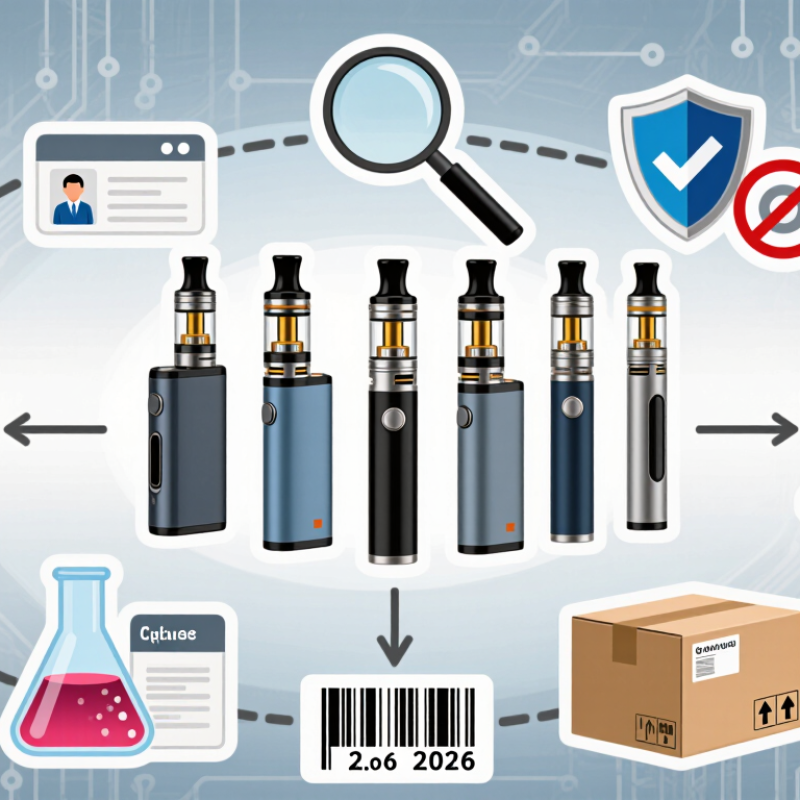
Before comparing suppliers, define the rules in the destination market. “Compliant” is not one universal specification. The WHO’s 2023 global tobacco report records e-cigarette regulation in 121 countries, while regulatory approaches differ widely. That variation makes a market-by-market checklist essential.
Check product classification, permitted ingredients, nicotine limits, device and packaging standards, warning labels, age controls, and required notifications. In the European Union, for example, the Tobacco Products Directive limits nicotine concentration in e-liquids to 20 mg/ml and refill containers to 10 ml. Treat those figures as regional requirements, not global defaults. Ask suppliers for current test reports, ingredient specifications, batch traceability, and label files; then compare each item with the destination authority’s latest guidance. Paperwork matters.
I still find labeling easy to underestimate. A correctly tested liquid can be delayed if its warning text, language, or package dimensions do not match local rules. Record the source and date of every requirement, and have a qualified local compliance specialist review the checklist before placing an order. Regulations change. A dated checklist is useful, but it is not a substitute for verification.
Use this market-by-market checklist to screen products and suppliers before ordering. Requirements may differ by product type, sales channel, and subnational jurisdiction.
| Target market | Core product requirements | Premarket approval or notification | Packaging and sales controls | Evidence to request from a supplier | Important sourcing risks | Official reference |
|---|---|---|---|---|---|---|
| United States | Electronic nicotine delivery systems are regulated as tobacco products. There is no general exemption for products described as “new,” “improved,” or “for adults only.” | A product generally needs an FDA marketing granted order to be legally marketed. A pending application is not an authorization. Check the exact product and variants against FDA records before purchase. | Federal minimum age of sale is 21. Applicable federal warning, labeling, advertising, and recordkeeping requirements must be met. State, tribal, and local rules may add restrictions. |
| State and local restrictions can cover flavors, online sales, licensing, taxes, and delivery. Do not rely solely on a supplier’s statement that a product is “FDA registered” or that an application has been filed. | U.S. FDA: ENDS |
| European Union | Under the Tobacco Products Directive, nicotine-containing e-cigarettes are subject to limits including a maximum nicotine concentration of 20 mg/ml, tanks or cartridges of no more than 2 ml, and refill containers of no more than 10 ml. | Manufacturers or importers must submit the required product notification to each relevant Member State at least six months before placing a product on that market. National notification systems, fees, and additional rules may apply. | Nicotine-containing products require prescribed health warnings and compliant packaging. Advertising, cross-border distance sales, flavors, and other rules may vary between Member States. |
| EU-level compliance alone may not satisfy a Member State’s additional restrictions. Confirm destination-country rules for flavors, online sales, taxes, and language before shipping. | EU Tobacco Products Directive 2014/40/EU |
| United Kingdom | For regulated nicotine-containing products, the main product limits include a maximum nicotine concentration of 20 mg/ml, a tank or cartridge capacity of 2 ml, and refill containers of no more than 10 ml. | Products must be notified through the UK Medicines and Healthcare products Regulatory Agency (MHRA) system at least six months before being placed on the market. Check the published notification information for the exact product. | Required warnings and packaging rules apply. Single-use vapes have been banned across the UK since 1 June 2025; products for the market must meet the applicable reusable-product requirements. |
| Check rules separately for Great Britain and Northern Ireland where relevant. Do not source disposable or single-use designs for UK sale; confirm current interpretations of “single-use” with the relevant authority. | UK government: E-cigarette regulations |
| Canada | Federal rules cap nicotine concentration in vaping products at 20 mg/ml. Products are also subject to federal product, ingredient, packaging, and reporting requirements. | Manufacturers and importers must meet applicable Health Canada notification and reporting obligations. Confirm the required filings and timing for the specific product and business role before commercial import or sale. | Federal labelling and packaging rules include nicotine-related information and health warnings. Provincial and territorial rules can restrict flavors, promotion, retail sales, and where products may be used. |
| A product meeting the federal nicotine limit may still be restricted by provincial or territorial rules. Review local excise, retail licensing, flavor, and online-sale requirements. | Health Canada: Vaping products |
| Australia | Vaping products are subject to a tightly regulated therapeutic-goods framework. Product classification, permitted ingredients, product standards, and supply route determine whether a product may be lawfully supplied. | Importation, manufacture, and supply are controlled. Confirm the applicable Therapeutic Goods Administration (TGA) requirements and lawful import or supply pathway before placing an order; ordinary consumer-goods compliance alone is not sufficient. | Pharmacy supply controls and restrictions on retail supply apply under the federal framework. State and territory laws can impose additional rules on possession, supply, and use. |
| Do not treat a product as compliant merely because it is available online or can be shipped internationally. Verify current federal and state or territory requirements before every shipment. | TGA: Vaping hub |
2026 due-diligence note: Regulations and enforcement guidance can change. Treat this table as a screening checklist, not legal advice. Before contracting or shipping, verify the current official rules for the exact product configuration, destination, importer, and sales channel; retain dated copies of approvals, notifications, test reports, and label reviews.