What Is Quartz Glass Used For?
Quartz Glass is valued for properties that ordinary glass cannot reliably provide in demanding environments. High-purity grades withstand intense heat, resist many chemicals, and transmit ultraviolet light. These qualities make quartz glass useful in semiconductor manufacturing, laboratory equipment, optical systems, and specialized lighting. Look closely at a semiconductor furnace: quartz tubes and wafer carriers help keep sensitive materials isolated during high-temperature processing. Grade and purity matter; not every quartz component performs the same way.
Industry figures show why these applications deserve attention, though they do not measure quartz-glass demand directly. SEMI reported that worldwide semiconductor-manufacturing equipment sales reached $117.1 billion in 2024, up 10% from 2023. The International Energy Agency’s Renewables 2024 report forecast nearly 5,500 gigawatts of renewable-power capacity additions between 2024 and 2030, with solar photovoltaic technology accounting for almost 80% of the increase. These trends point to expanding industries that use specialized materials, including quartz glass in selected processes and components. They are context, not proof of a one-to-one rise in quartz consumption. That distinction matters. This introduction explores where quartz glass is used, what its properties contribute, and where its limits deserve closer scrutiny. Practical details can vary by application, manufacturer, and material grade. The material is impressive, but it is not a universal solution.
Quartz Glass Basics: Fused Silica Expands by Only About 0.5 × 10⁻⁶ K⁻¹
Fused silica is valued when temperature changes must not shift a component very far. Its thermal expansion coefficient is about 0.5 × 10⁻⁶ K⁻¹. In practical terms, a one-meter piece expands roughly 0.05 millimeters when heated by 100°C. That small movement matters in optical systems, where a lens or window must stay aligned. It also helps quartz glass tolerate rapid heating better than many ordinary glasses.
You can find fused silica in precision optical windows, laboratory vessels, lamp envelopes, and equipment exposed to high process temperatures. Picture a clear tube warming near a hot zone: its dimensions change only slightly, helping maintain fit and function. Still, low expansion does not mean “immune to thermal shock.” Uneven heating, surface flaws, or a tight mounting can create stress and cause cracking. Details matter.
The number is a useful guide, not a promise for every part. Composition, manufacturing quality, shape, and temperature range can affect performance. A thick component may also develop a steep temperature gradient, even when its average expansion is low. It is easy to overstate the advantage. For a real design, engineers check the material grade and the full temperature cycle, then consider how the part is supported.
Optical Uses: High-Purity Grades Transmit Ultraviolet Light Down to About 185 nm
High-purity quartz glass, more precisely fused silica, is valuable in optics because it can transmit ultraviolet light that ordinary glass absorbs. The CIE’s International Lighting Vocabulary defines ultraviolet radiation as 100–400 nm, placing 185 nm in the UV-C range. Industry optical-materials data sheets commonly show transmission extending to about 185 nm for selected high-purity grades. That figure is not a guarantee for every piece: thickness, impurities, and surface quality all affect measured transmission.
This makes suitable fused silica useful for UV spectrometers, lamp envelopes, and optical windows. At 185 nm, even a small amount of contamination can reduce throughput. Oxygen in the beam path also absorbs strongly at these wavelengths, so instrument designers may need a purged or evacuated path. A clean-looking window can still perform poorly. That part is easy to overlook.
Tips: Check the grade’s transmission curve at your intended wavelength and sample thickness. Confirm how transmission was measured; a stated cutoff alone may hide meaningful losses near 185 nm.
Semiconductor Manufacturing: Quartz Components Support High-Temperature Wafer Processing
In semiconductor manufacturing, quartz glass helps hold wafers during high-temperature processing. High-purity fused quartz is used for items such as process tubes, wafer boats, and chamber components. It tolerates substantial heat and can remain dimensionally stable under carefully controlled conditions. That matters when wafers pass through repeated heating and cooling cycles. A clean quartz surface also helps limit unwanted contamination, though no material is perfectly immune to deposits or wear.
It is not indestructible. Rapid temperature changes can cause stress, and repeated exposure may gradually alter a component’s surface. Tiny cracks or residues can be difficult to spot, yet they may affect process consistency. Component selection depends on the specific temperature range, atmosphere, and cleaning routine. Quartz is useful, but process conditions still set its limits.
Tips: Inspect components for chips, cloudy areas, and residue before use. Follow the process supplier’s cleaning and handling guidance. Avoid sudden temperature shifts. If a part looks questionable, replacing it may be safer than assuming it will perform as before. Some wear is easy to miss.
Quartz Glass in Semiconductor Manufacturing
Quartz components such as furnace tubes and wafer boats are used in high-temperature processing. The chart shows representative process temperatures; actual recipes vary by material and equipment.
Thermal Equipment: Quartz Glass Softens at About 1,665°C
What Is Quartz Glass Used For?
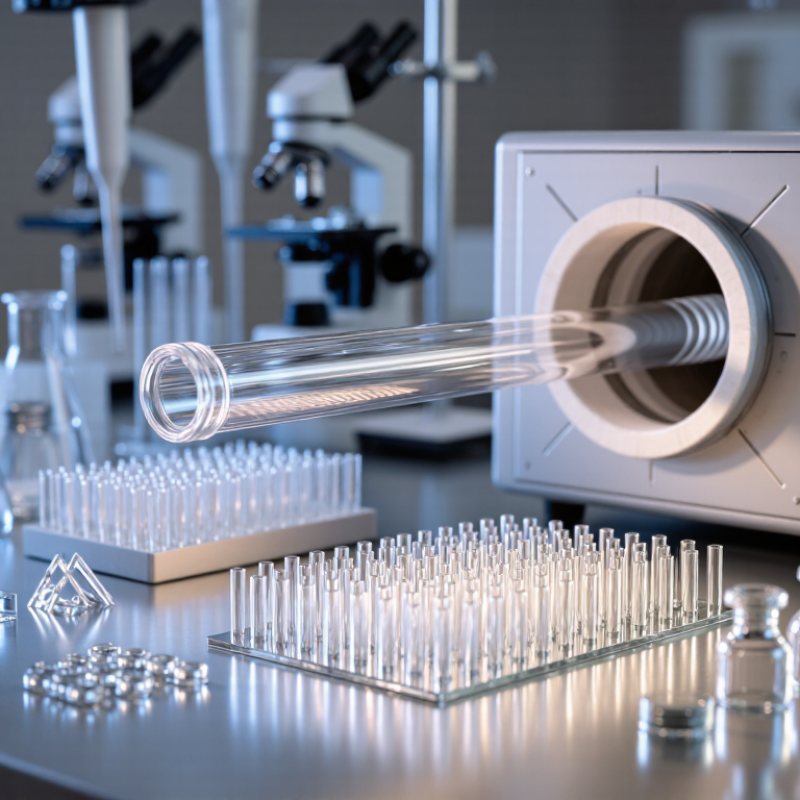
Quartz glass is used in thermal equipment because it handles intense heat and changes shape slowly. Its softening point is about 1,665°C, but this is not a safe working temperature for every component. Softening means the material can deform under load; it does not mean a part can operate continuously at that temperature. In a furnace, a quartz tube may carry hot gases or shield a sensor from direct flame. A clear tube also lets technicians observe a process without opening the chamber. Useful, but not indestructible.
The material’s low thermal expansion helps it withstand rapid temperature changes better than ordinary glass. A quartz sleeve can be heated quickly, then cooled, with less risk of cracking from thermal stress. Still, uneven heating, mechanical pressure, or prolonged exposure near its softening range can distort it. Surface deposits and impurities may also affect performance over time. The exact limit depends on the part’s shape, load, atmosphere, and heating cycle. That detail is easy to overlook. For reliable equipment design, engineers use the softening point as a reference, then set operating limits well below it and inspect components for sagging or surface damage.
Industrial and Scientific Uses: Tubes, Crucibles, Labware, and Optical-Fiber Preforms
Quartz glass is valued where ordinary glass may soften, deform, or contaminate a process. Its low thermal expansion helps it withstand rapid temperature changes, while high-purity grades suit demanding industrial and scientific work. Tubes carry hot gases, protect sensors inside furnaces, or form parts of chemical-processing equipment. A clear tube can reveal deposits or bubbles during inspection. Small details matter.
Crucibles made from quartz glass hold materials during high-temperature processing and analysis. The material can reduce contamination, but it is not suitable for every melt or chemical; compatibility depends on temperature, composition, and exposure time. Repeated heating may also cause surface changes or gradual devitrification. This is easy to overlook. Labware, including dishes and reaction vessels, benefits from heat resistance and optical clarity, though users still need to check the grade and cleaning procedure for each application.
Quartz glass also forms the core material for optical-fiber preforms. These carefully shaped rods contain layers designed to guide light once the glass is drawn into thin fiber. Their geometry and refractive-index profile must remain consistent along the length. A small flaw can affect the finished fiber, so inspection and process control are essential. Preforms are not just larger pieces of glass; they are precision components made for a specific optical design.