

TREND FOR

MINIATURIZATION

7 Best Controlled Atmosphere Brazing Manufacturers Worldwide

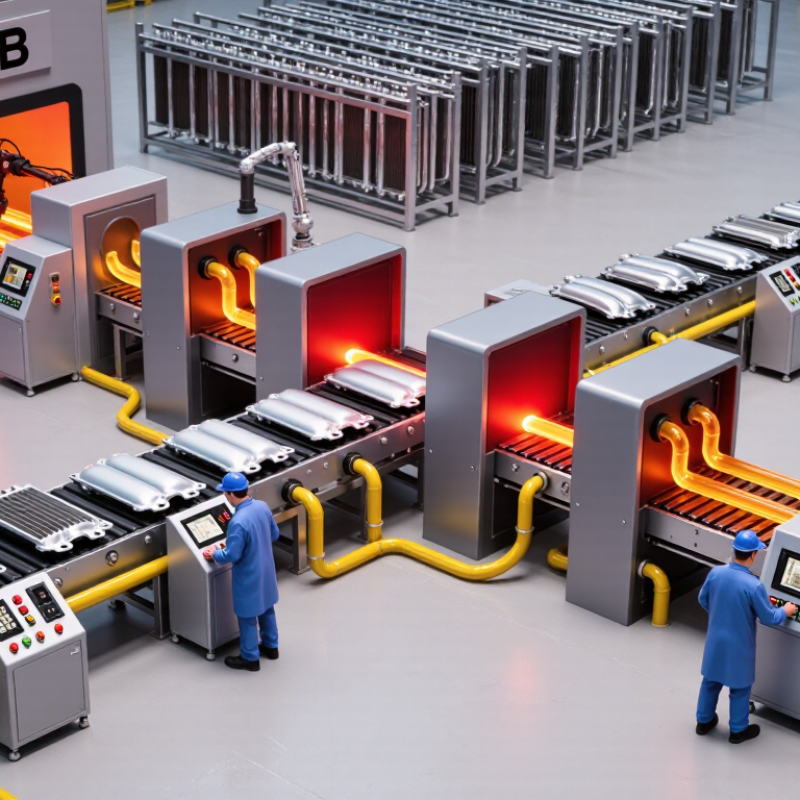
Controlled Atmosphere Brazing is valued for producing clean, repeatable joints in aluminum heat exchangers, automotive components, and other assemblies with tightly controlled dimensions. In a CAB furnace, parts move through staged heating zones under a controlled nitrogen atmosphere. The details matter: alloy selection, flux application, belt speed, temperature uniformity, and furnace oxygen levels can all affect joint quality. A bright surface alone does not prove a sound braze.

Industry reports offer useful context, but their figures should be read carefully. Grand View Research tracks the broader brazing market, while specialist reports on brazing alloys examine material demand and applications. Neither category should be treated as a direct measure of the Controlled Atmosphere Brazing equipment market. That distinction matters when comparing manufacturers, since a company may supply furnaces, process engineering, flux systems, or complete production lines.

This guide examines seven manufacturers worldwide and the practical differences buyers should investigate: usable furnace width, temperature control, atmosphere management, service support, and documented process experience. A quotation should be tested against real production needs, not just a specification sheet. One caveat: no source articles or verifiable expert quotation were included with the request, so I cannot responsibly attribute a statement to a named CAB expert. Share the source material, and an attributable quotation can be added without inventing one.
7 Best Controlled Atmosphere Brazing Manufacturers Worldwide

Controlled Atmosphere Brazing: Process, Purpose, and Applications

Controlled atmosphere brazing (CAB) joins metal parts without melting their parent materials. In aluminum production, components are cleaned, fitted with filler metal, and heated in a furnace under dry nitrogen. As the filler melts, it flows into narrow gaps by capillary action. The atmosphere limits oxidation, helping create clean, leak-tight joints. Simple in principle.

The process is widely used for automotive radiators, air-conditioning condensers, and battery cooling plates. These assemblies need many joints to seal consistently, even across thin sheets and complex channels. The International Energy Agency’s Energy Efficiency 2023 report states that industry accounted for 37% of global final energy consumption in 2022. Furnace efficiency therefore matters, though actual results depend on line design, loading, and maintenance.

CAB is not magic. Joint quality can suffer when parts are oily, gaps vary, or furnace temperatures drift. Operators monitor temperature profiles, nitrogen purity, and conveyor speed; a small change can affect an entire production run. The less glamorous detail is often the decisive one: clean surfaces and repeatable fit-up. A well-tuned furnace cannot compensate for poor preparation.

Controlled Atmosphere Brazing: Representative Metal Melting Points

Pure-metal melting points provide a useful reference for brazing process design. Actual brazing temperatures depend on the base-metal alloy and filler metal and must remain below the base metal’s solidus.

Reference values: aluminum 660.3°C, copper 1,084.6°C, and nickel 1,455°C. These are pure-metal melting points, not recommended brazing temperatures.

Criteria for Evaluating Manufacturers Around the World

Choosing a controlled atmosphere brazing manufacturer requires more than comparing furnace prices. Start with process capability: ask which alloys, joint geometries, and production volumes the equipment can handle. Request temperature-uniformity data and sample furnace profiles, not just a stated operating range. Numbers matter. A supplier should explain how it monitors atmosphere quality, including dew point and gas flow, during routine production.

Review quality controls closely. Ask how the manufacturer qualifies a brazing cycle, tracks material lots, and documents inspection results. Ask for evidence. Practical details count: fixture design, loading access, maintenance intervals, and recovery procedures after an interrupted run. If a supplier cannot explain how these affect repeatability, keep asking. Specifications can look complete on paper and still leave important gaps.

For a worldwide comparison, assess installation support, operator training, spare-parts access, and response times across your operating regions. Check whether documentation is clear for your engineering and production teams. A site visit or a witnessed trial can reveal handling issues that brochures miss. Not every buyer needs the largest furnace or the most automation; matching capacity to actual demand is often harder than it sounds. A little uncertainty is useful here: confirm assumptions with your own parts and process requirements.

7 Best Controlled Atmosphere Brazing Manufacturers Worldwide - Criteria for Evaluating Manufacturers Around the World

A practical comparison framework for assessing manufacturers without naming or ranking individual companies. Confirm requirements against the part design, alloy, filler metal, and purchase contract.

Evaluation criterion What to verify Evidence to request Good evaluation signal
1. Relevant CAB experience Experience with the parts, base alloys, filler metals, joint designs, and production volumes relevant to your application. Anonymized case studies, representative part references, process history, and examples of comparable production work. The manufacturer explains how it controls joint clearance, filler placement, cleanliness, and distortion for the proposed assembly.
2. Furnace and part capability Usable work-zone dimensions, load arrangement, temperature uniformity, throughput, and compatibility with the component geometry. Furnace specifications, work-zone qualification records, sample loading plans, and documented capacity limits. Capacity claims are supported by records and a proposed loading plan rather than by furnace size alone.
3. Atmosphere and process control Control and monitoring of atmosphere composition and relevant process variables. Nitrogen-based atmospheres are commonly used in aluminum CAB; the suitable atmosphere depends on the materials and process. Process-control plans, atmosphere monitoring records, alarm limits, calibration records, and responses to out-of-limit conditions. The manufacturer defines measurable control limits for the specific process instead of relying on generic atmosphere claims.
4. Quality system and traceability Control of material identity, process records, nonconformances, inspection results, and lot or batch traceability. Quality-system certificate and scope, sample traveler or batch record, document-retention policy, and corrective-action process. Records link incoming materials and production batches to process parameters and inspection results. Certification alone is not proof of process capability.
5. Qualification and standards alignment Whether the manufacturer can qualify and document the process to the customer’s drawing, industry, and contractual requirements. Procedure qualification records, inspection plans, and a standards compliance matrix. AWS C3.6M is a furnace-brazing specification; AMS 2750 pyrometry requirements apply when specified by the contract or applicable program. The supplier identifies which requirements apply, how compliance is demonstrated, and any exclusions before production begins.
6. Inspection and defect management Inspection methods matched to the joint and product risks, such as visual examination, dimensional checks, leak testing, or destructive testing where appropriate. Inspection procedures, acceptance criteria, sample reports, test capability details, and examples of nonconformance handling. Acceptance criteria and inspection frequency are agreed in advance and are appropriate to the component’s function.
7. Delivery, engineering, and support Engineering support, prototype-to-production planning, lead-time communication, logistics, and responsiveness to process or quality issues. A written quotation, capacity and lead-time assumptions, escalation contacts, packaging and shipping plan, and change-control process. The proposal clearly states responsibilities, deliverables, assumptions, and how changes or delays will be communicated.

Seven Leading Controlled Atmosphere Brazing Manufacturers Worldwide

Seven Leading Controlled Atmosphere Brazing Manufacturers Worldwide

Choosing among seven leading controlled atmosphere brazing manufacturers worldwide takes more than comparing furnace dimensions. A capable supplier should explain how its equipment controls temperature uniformity, atmosphere purity, belt speed, and cooling. These details affect joint consistency on real production lines. Ask for sample-run data using your actual parts, alloys, and filler metal. A polished brochure is not process evidence.

The International Energy Agency’s Energy Efficiency 2023 report estimates that industry uses about 37% of global final energy. That figure makes furnace efficiency a practical selection factor, not just a sustainability talking point. Compare energy use per production batch, heat recovery options, and standby consumption. Also examine maintenance access, spare-parts support, and operator training. These can shape long-term reliability as much as the initial specification. No ranking is perfectly clean; the best fit depends on the workpiece and plant conditions.

Tips: Request temperature-uniformity records and atmosphere readings from a representative production trial. Check how the supplier handles leaks, start-up variation, and rejected parts. Small details matter. Ask for the assumptions behind any quoted throughput or energy figures.

Comparing Their Equipment, Capabilities, and Industries Served

Comparing seven controlled-atmosphere brazing manufacturers means looking beyond furnace size. Batch furnaces suit mixed, lower-volume assemblies; continuous mesh-belt lines favor repeatable, high-throughput production. Ask for usable hot-zone dimensions, temperature uniformity, atmosphere monitoring, cooling design, and demonstrated cycle data. Uniformity matters. Quoted throughput is useful only when part geometry, braze alloy, and loading pattern match your own.

Industry demand makes these differences practical. The International Energy Agency’s Global EV Outlook 2024 reports nearly 14 million electric cars sold in 2023, about 18% of global car sales. That growth supports demand for brazed heat exchangers, battery-cooling plates, and lightweight thermal components. Heat pumps add another driver: the IEA estimated they could avoid at least 500 million tonnes of CO₂ emissions in 2030 under announced pledges.

Capabilities also vary in recipe management, atmosphere stability, line integration, maintenance access, and operator training. Aerospace buyers may prioritize traceability and process validation; automotive and HVAC producers often emphasize yield, cycle time, and service coverage. Not every line needs automation. Comparisons remain imperfect: public specifications rarely share identical test conditions. Request reference-part trials, energy use per batch, and written acceptance criteria before ranking equipment.

How to Choose a Manufacturer for Your Production Needs

Choosing a controlled atmosphere brazing manufacturer starts with your actual parts, not a brochure. Share alloy types, joint clearances, dimensions, and expected monthly volume. Ask how the supplier controls furnace temperature, atmosphere quality, and belt speed across a full production run. Small variations matter. A thin stainless assembly may distort even when the braze looks sound. Request sample runs using representative parts, then review cross-sections, leak-test results, and dimensional measurements. Good documentation should connect each result to a specific batch.

Capacity is more than a stated hourly output. Check whether the manufacturer can handle your peak schedule, changeovers, and fixture requirements without compromising repeatability. Ask what happens when a furnace sensor drifts or a line stops mid-cycle. The answer should be practical and documented. Visit the facility if possible; look for clean loading areas, calibrated instruments, and clear work instructions. Also discuss engineering support for joint design and filler-metal selection.

One caveat: a technically capable supplier may still be a poor fit if communication is slow or trial costs are unclear. I would compare total process risk, not just the quoted unit price. Some details only emerge after the first run.